

Northern Territory
Fortitude
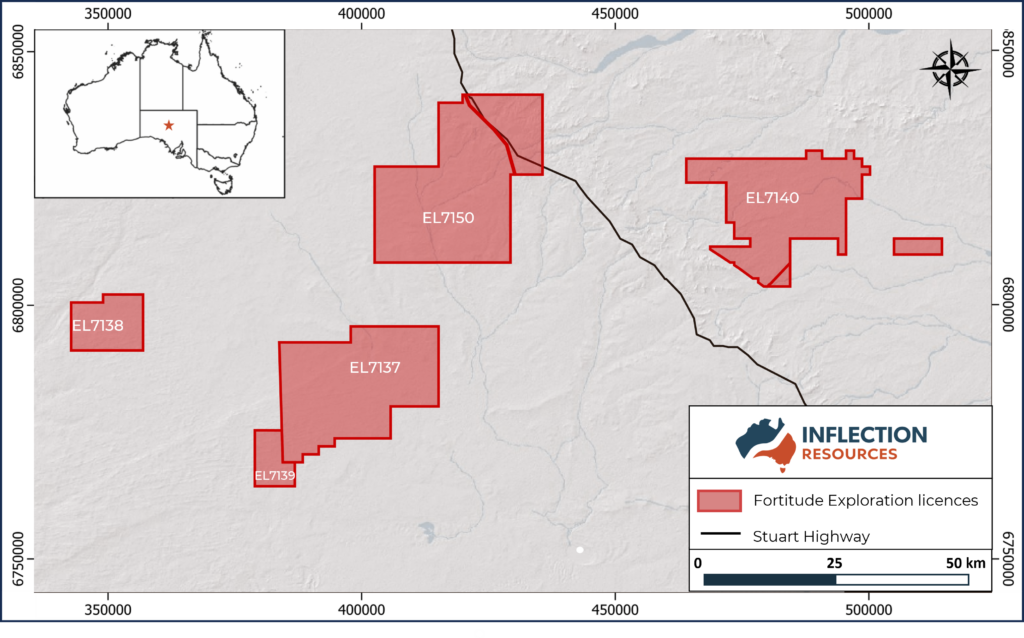
The Fortitude Project is a district-scale exploration opportunity located in South Australia’s Gawler Craton, within the broader Olympic Dam IOCG Province, approximately 290 km northwest of BHP’s Olympic Dam mine. The project covers approximately 2,660 square kilometres and is considered highly prospective for concealed iron oxide copper-gold (IOCG) and iron sulphide copper-gold (ISCG) mineralisation. The portfolio is 100%-owned and royalty-free, and was announced by the Company on September 21, 2026.
Targets
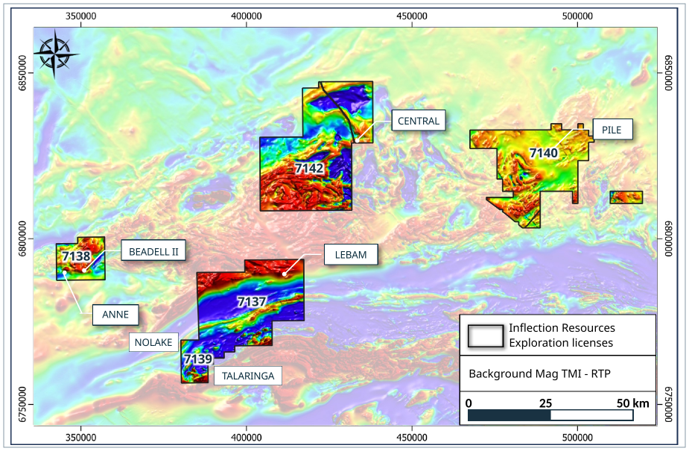
- Inflection has identified seven undrilled targets across the Fortitude Project, comprising six prospective for concealed IOCG/ISCG systems and one intrusion-associated gold target. Each target is defined by its structural setting, magnetic and gravity architecture, interpreted alteration and estimated depth to target.
- The targets were generated using a mineral-systems methodology developed by Douglas Haynes, which links a fertile source of metals and fluids to crustal-scale structural conduits that focus fluid flow into favourable chemical or structural traps where iron oxides, copper and gold are deposited, rather than relying on isolated geophysical anomalies alone.
Beadell II Target
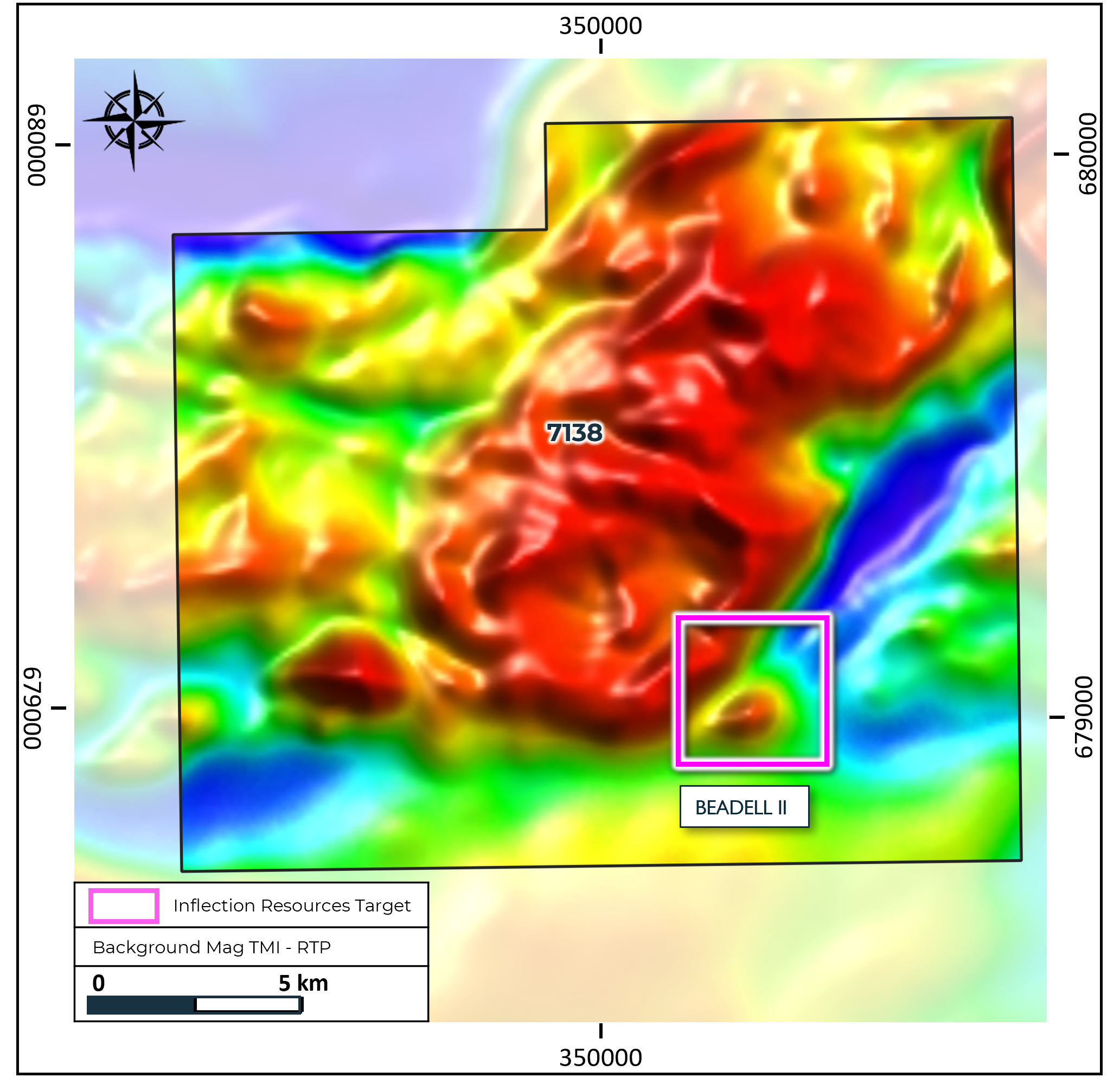
The Beadell II Target is the portfolio’s most highly ranked target based on current geological and geophysical criteria. It lies on a large, interpreted fault corridor with a distinct magnetic anomaly and coincident Bouguer gravity response, interpreted to be located at approximately 150 metres depth. Beadell II represents a high-conviction, high-priority target within the Fortitude portfolio.
Lebam Target
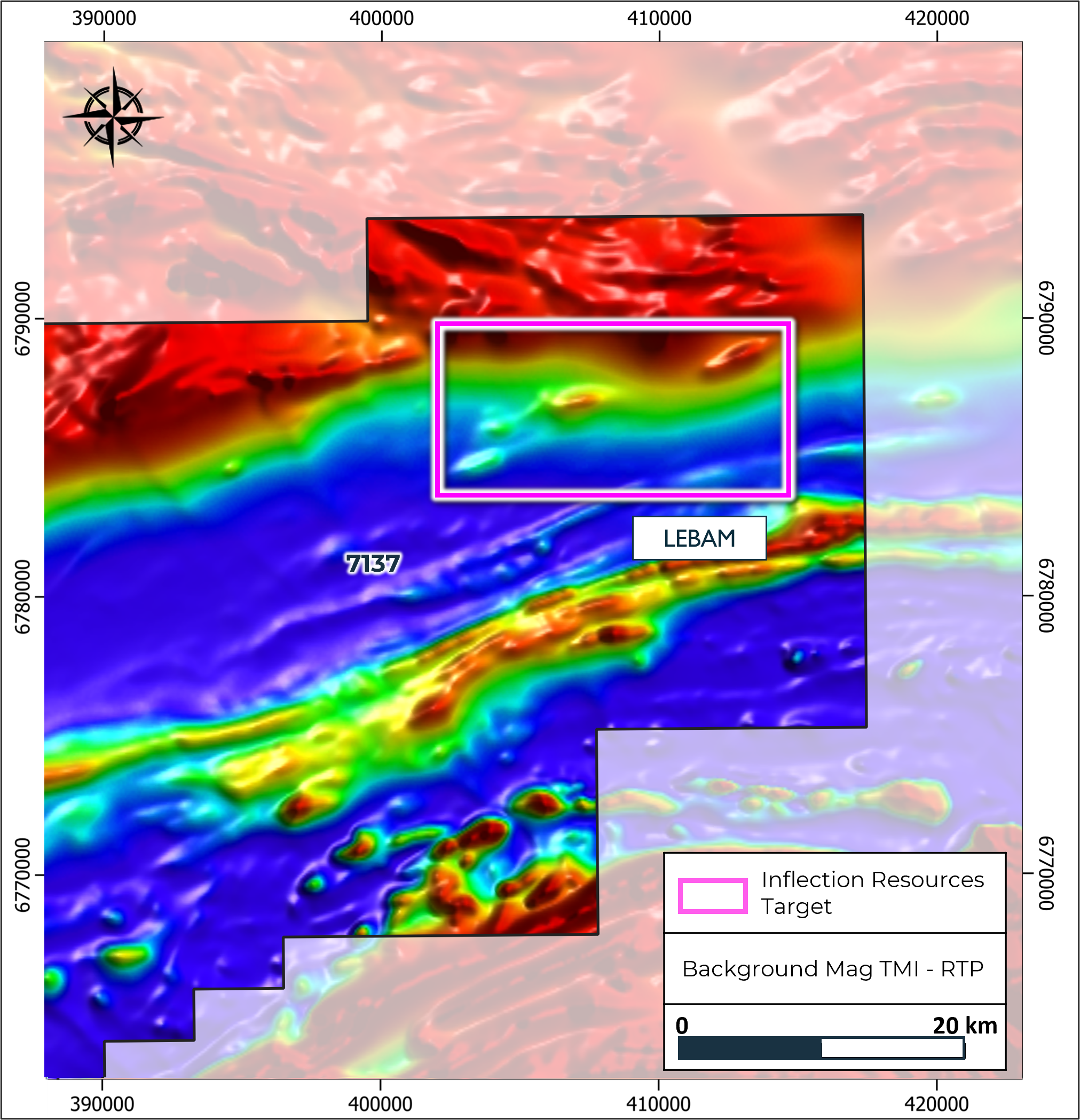
The Lebam Target is positioned on a regional-scale, northeast-trending interpreted fault corridor, with a coincident Bouguer gravity anomaly, aligned magnetic anomalies and a preliminary interpreted target depth of approximately 200 metres.
Iron Oxide Copper Gold (IOCG) Deposits
IOCG deposits are among the most metal-rich hydrothermal mineral systems globally, with Australia’s Olympic Dam and Ernest Henry ranked as two of the largest deposits in terms of contained copper, gold and by-product metals.
In South Australia, the Olympic Dam Mine is one of the world’s largest known deposits of copper, uranium and gold, hosted within Mesoproterozoic rocks. In Queensland, Ernest Henry is a magnetite-rich breccia pipe hosted in Proterozoic volcanics. Ernest Henry’s strong geophysical signature, particularly in magnetics, gravity and IP, serves as a working exploration model for Inflection’s Endurance targets. Additionally, BHP’s Carrapateena mining operation in South Australia and the Candelaria Mining Complex in Chile, owned by Lundin Mining Corporation, are other examples of world-class IOCG districts.

Synthesis of the hydrothermal origins of select IOCG systems, their tectonic setting and fluids involved in economic Cu-Au mineralisation (Not to scale). The schematic block models are compiled from published studies and illustrate the geometries of zoned iron oxide-alkalic-calcic-hydrolytic alteration patterns and the location of Cu-Au ore bodies (Modified from Schlegel et al., 2020) – Schlegel et al. 2025
Exploration for IOCG deposits is typically guided by integrated geophysical surveys, with gravity and magnetic data forming the foundation of target generation. The distinctive density and magnetic contrasts created by iron oxide-rich alteration systems often produce characteristic anomalies that can be detected at depth, even beneath significant cover sequences. IP surveys have proven particularly valuable in delineating sulphide-bearing mineralisation within these systems, while detailed ground magnetic surveys can help define structural controls and breccia geometries. The discovery of concealed IOCG deposits often requires a systematic mineral-systems approach that combines regional-scale geophysical data interpretation with geological understanding of favourable host rock sequences and key structural settings.